skip to main |
skip to sidebar
 |
| Bucovina Monastery |
The Bucovina Monasteries are a cluster of churches in the Eastern Carpathians, decorated inside & out with bright frescos. Overhanging roofs shelter the pigment against the Romanian weather. In the medieval era when literacy wasn’t widespread, the frescos acted as stark pictorial warnings for those who wavered from orthodoxy. I hired Gigi, a local guide, and we visited Humor, Voronet, Moldovita & Sucevita; each with its own biblical themes, & all beautiful.
I asked Gigi, about the Communist era. He was a teenager in the late eighties and the Ceaucescus were executed days before his enforced conscription. Widespread resentment was already in the air & he told me he would have been lining up against his friends, rifle in hand. He described his mother queuing endlessly for bread while he flicked between the two state televisions channels, hopping between propaganda, praying for an end to the old order.
 |
| Chisinau, Moldova |
From Suceava in Romanian Bucovina, I headed to Chisinau in Moldova. The only bus of the week left Suceava at 6am. I walked through the dark to the small bus station only to find the minibus full-up. “But I’ve come all the way from England!” I said. Some shrugging was the only response. Hiding at the back of the bus station was another bus which went part of the way, leaving at 7. At 7.45 it broke down in a forest. At 8.30 another bus picked us up from the forest and drove to the next town. A further bus took me to Iasi near the border and from there I could connect to Chisinau.
As soon as we entered Moldova, everyone began bouncing up & down. We had now left the EU with its infrastructure grants & road maintenance. Moldova’s highways are domestically funded, bumpy & unsealed. As we approached Chisinau, the fertile fields were planted with rows of grapes, wrapping the capital in vines. We juddered into the bus station in late afternoon sunshine. One simple journey had become four and yet we arrived an hour ahead of the rammed 6am bus from Suceava!
 |
| Coffee & cake in Moldova |
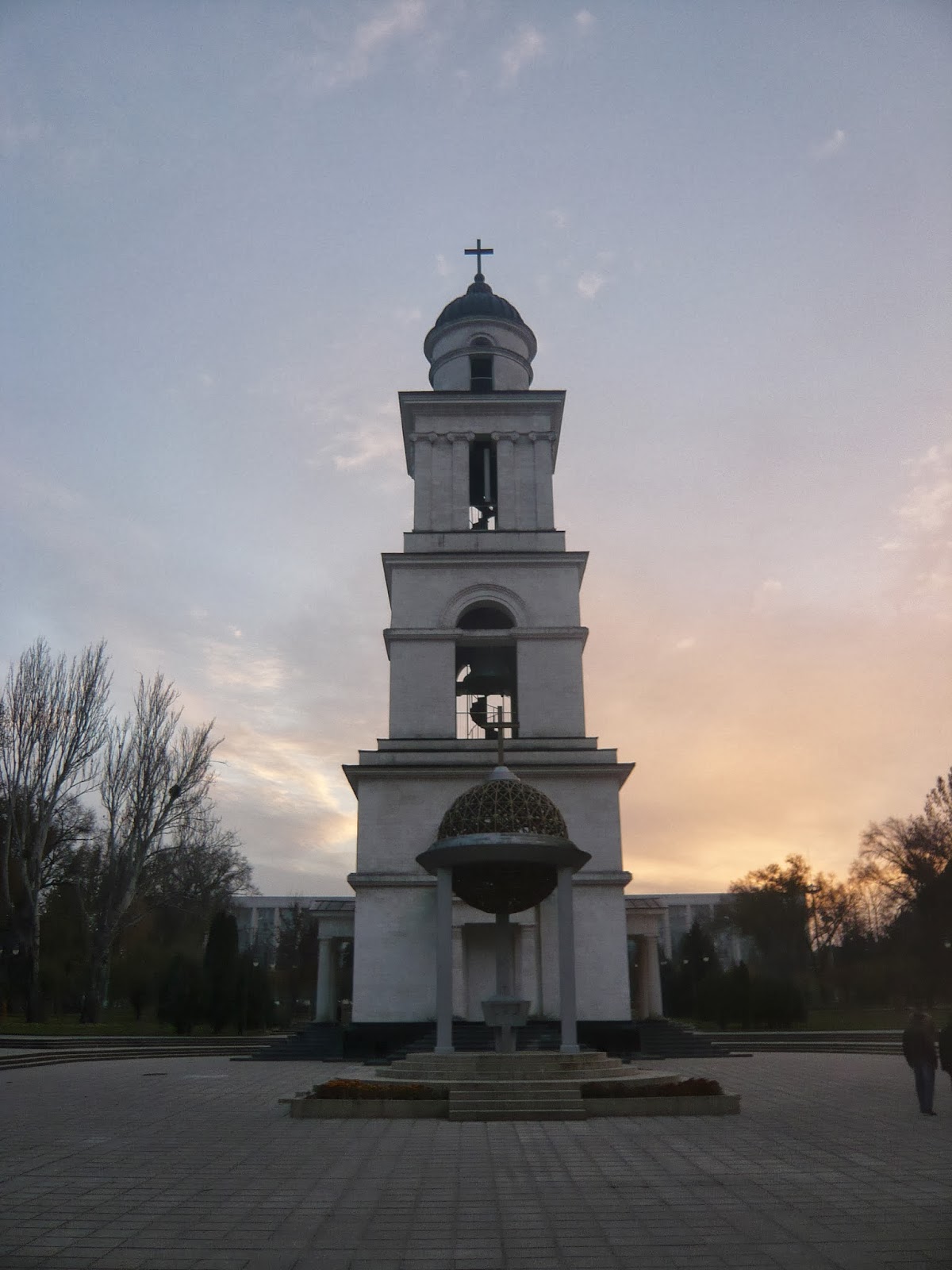
I checked into a Junior Suite at the Hotel Tourist, a centrally-planned slab of downtown accommodation. After the colour-rush of the Bucovina monasteries, it was a return to communist brown; all the shades from beige to taupe. On the surface, Chisinau was crumbling; all rain-stained estates & wrecked pavements. Anti-fascist memorials rose proudly from intersections. The familiar clenched fists & red stars of Eastern Bloc progress. There was a cheek-by-jowl clash of post-war brutalism and neon-strip casinos; a complete absence of architectural harmony. But secreted inside was a brighter story. Bleak facades hid cosy cafes, modern enotecas & amusingly, Malldova. Here lived the capital’s young, flash with iphones & tablets, served by waitresses in traditional dress, everyone fluent in Russian & English.
 |
| Timisoara |
From Chisinau, I flew to Timisoara in Romania, where the revolution to overthrow the Ceaucescus begun. The light was fading as I arrived, but the city appeared tidy & prosperous and proud of its role in igniting the revolution. From Timisoara the dissent spread to Bucharest and gained enough momentum to topple one of the worst of the Soviet-endorsed regimes. Way up in Bucovina in the remote north, a teenager called Gigi, with a love of the local monasteries, was just relieved it all happened before he was called up to shoot his mates.
 I bought my ticket and sat outside the small bus station in Dilijan. This pretty Armenian spa town quietly markets itself as Little Switzerland & is perched high in the green hills, far away from the dusty earthquake-battered capital, Yerevan. It was the final bus of the day and the sun was dipping into the horizon. It was also twenty minutes late and the driver, in a bid to recover time, accelerated past the terminal. I stood up, flapping my arms around. Two staff from the bus station came out, also flapping their arms & then disappeared back into the station. The bus turned a corner and left town. If I didn’t get to Vanadzor, I couldn’t get to Tbilisi in Georgia. If I couldn’t get to Tbilisi, I couldn’t get home to London. I was travel-stained & tired. So, I did what I always do in situations of utter hopelessness. I kicked my rucksack.
 |
| Concrete Beauty |
But then the two bus station employees reappeared & ushered me into a mud-splattered minivan. We raced off in pursuit, running red lights and leaning on the horn to scatter the traffic. Luckily our target was an old American school bus and we glimpsed its taillights a mile out of town, crawling up an incline in first gear. The minivan shunted past and drew to an abrupt stop in front of the startled driver. There followed a further series of arm signals until the bus door hissed open and I climbed the steps waving my ticket and pointing back to the town trying to explain the situation in the absence of shared language.
After this unlikely start, the bus inched up a narrow ridge riding above the beautiful villages belonging to the Molokans. Rejecting orthodoxy, the Molokans are an ultra-conservative group who face away from the modern world and live in steep green valley settlements like Fioletovo.
The bus crunched through the narrow passes with the valley spread out below; patterned by hayricks and smoking chimneys & populated by men on horseback and women in black headscarves. Lilac dusk dropped across the valley and as the light diminished and the senses readjusted, the tang of woodsmoke drifted into the bus and I slept the final miles into Vanadzor. This is how I will always remember Armenia; a beautiful journey made possible by a spontaneous act of kindness.


